
The 4 decision gaps that kill ideas before the first build
Four recurring unknowns—buyer, priced pain, MVP boundary, and differentiation—silently stall ideas. Use these questions to commit to a build-ready plan.
Why promising ideas stall: decision gaps, not lack of effort
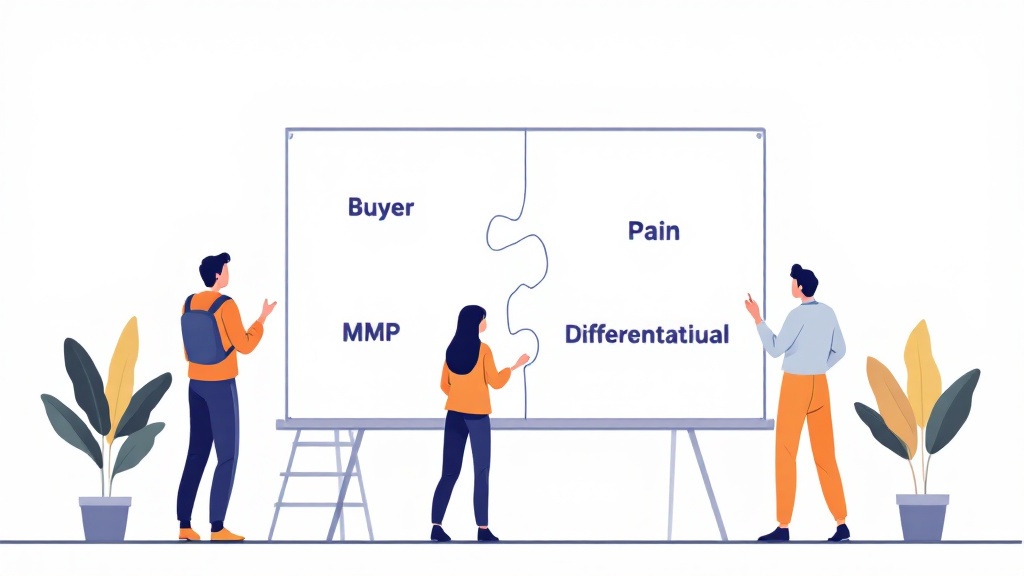
Most early products don’t fail because the team can’t build—they fail because the team can’t decide. In customer-discovery calls, you’ll hear energized founders describe features, integrations, and even a launch plan, yet the core product-strategy choices remain fuzzy. That ambiguity turns every next step into debate: which user to design for, what to charge, what to cut, and why a buyer would switch.
Across MVP and go-to-market work, four “unknowns” show up repeatedly: unclear buyer, unpriced pain, undefined MVP boundary, and fuzzy differentiation. When any one is missing, momentum dies: prototypes become Franken-products, timelines slip, and confidence drops because nobody can explain what success looks like.
A simple rule: if you can’t write these decisions down in one page, you can’t reasonably ask a team (or an accelerator cohort) to commit to a first release. The goal isn’t perfection—it’s fast-profit focus: a scoped bet you can validate with the first 20 customers.
Gap #1 and #2: unclear buyer and unpriced pain (the customer-discovery traps)
Gap #1: Unclear buyer. Red flag language: “This is for everyone,” “SMBs,” or “teams” without naming who signs the check. In customer-discovery, push for a single primary buyer with urgency and budget authority. Diagnostic questions: Who feels the pain weekly? Who owns the metric? Who approves spend? What event triggers action (audit, churn, missed SLA, regulatory deadline)? If you can’t point to one role, your go-to-market will splinter and your MVP will bloat.
Gap #2: Unpriced pain. Another common stall: the problem is described emotionally but not economically. Red flags: “It’s annoying,” “It wastes time,” or “We’ll be cheaper.” Convert pain into dollars: What does this cost per month? How many hours, errors, no-shows, refunds, or tickets? What’s the current workaround cost (labor + tools + risk)? When the pain is priced, product-strategy becomes easier: you can set a plausible price, define ROI, and prioritize features that move the buyer’s budgeted metric.
Gap #3 and #4: undefined MVP boundary and fuzzy differentiation (how to document decisions and commit)

Gap #3: Undefined MVP boundary. Red flags: “Phase 1 includes…” followed by a long backlog, or “We need integrations before we can test.” A real MVP is one use case for one buyer with a measurable outcome. Diagnostic questions: What is the single job-to-be-done? What must be true for a user to get value in one session/week? What do we deliberately exclude for 60 days? What metric proves pull with the first cohort (activation, weekly usage, retention, paid conversion)? This is the heart of MVP planning.
Gap #4: Fuzzy differentiation. If your answer is “better UX” or “AI-powered,” you’ll lose the first sales conversations. Ask: What alternative are they using today? Why would they switch now? What do we do that the workaround can’t—cheaper, faster, compliant, fewer steps, higher accuracy? Then document the four decisions in a lightweight one-pager (buyer, priced pain, MVP scope, differentiation) with assumptions, risks, and next experiments. MVP Compass is built to turn messy notes into that build-ready PRD so a team can align, ship, and run a focused go-to-market test.